Study Abroad Is Becoming Employment-Led: What Indian Students Must Understand
For a long time, the Indian study abroad story was told in a very simple sequence.
Get the grades. Build the profile. Secure the admittance. Arrange the finances. Get the visa. Fly out.
That sequence still exists, but in 2026, it is no longer enough. A student can do every one of those things correctly and still make a weak study abroad decision if the course, country, and career pathway do not align.
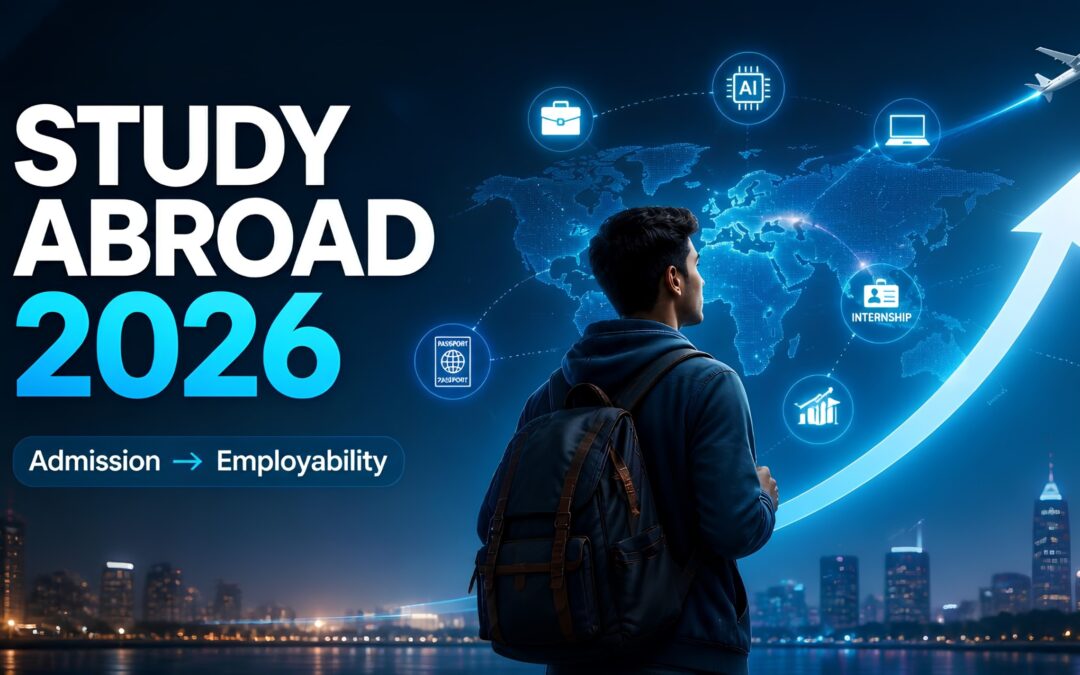
That is because the global study abroad market is no longer admission-led in the way it once was. It is becoming employment-led.
Students are still applying for degrees, but families are increasingly paying for outcomes: employability, work rights, career mobility, salary potential, industry relevance, and long-term security. In other words, the old question was, Can I get in? The new question is, What will happen after I get in?
That is the shift Indian students must understand.
Because today, a foreign degree is not valuable simply because it is foreign. It is valuable only if it builds the right skills, in the right market, with the right post-study pathway, at the right time.
That is why admission is not the finish line anymore. Employability is the test.
The Old Study Abroad Playbook Is Weakening
Part of the problem is that many students still use an older model of thinking. They choose destinations based on reputation, social proof, family familiarity, or the belief that any degree from a popular country will automatically lead to work.
That assumption has become much harder to defend.
The World Economic Forum’s Future of Jobs Report 2025, published on January 7, 2025, found that 39% of workers’ core skills are expected to change by 2030. The report says demand is rising not only for technical skills like AI and big data, networks and cybersecurity, and technological literacy, but also for human capabilities like creative thinking, resilience, leadership, and social influence.
LinkedIn’s Work Change Report, released in January 2025, makes the picture even sharper. It says that by 2030, 70% of the skills used in most jobs will change, and that since 2022, the rate at which LinkedIn users add new skills to their profiles has increased by 140%.
That means a degree is no longer enough if it does not translate into a marketable skill stack. Students are not walking into stable, slow-moving job markets. They are graduating into fast-changing, employer-filtered, AI-affected, immigration-linked systems. That is why study abroad decisions now need to be made like career decisions, not just education decisions.
Indian Students Are Still Moving at Scale, But the Risks Are Clearer Now
According to a Ministry of External Affairs reply tabled in the Rajya Sabha on December 4, 2025, there were 1,254,013 Indian students in universities and tertiary institutions abroad as of January 1, 2025, across 153 countries. If students in schools are included, the total reaches 1,882,318.
That is a huge national footprint. But the same parliamentary reply also shows the harder side of international mobility. Over the last five years, Indian students were deported or denied entry in multiple destinations:
- 170 Indian students deported from the UK
- 45 Indian students deported from the US
- 629 Indian students denied entry to the US
- 114 Indian students deported from Australia
The reasons cited by the MEA include:
- Breach of student visa conditions
- Undertaking unauthorised employment
- Inability to maintain required financial balances
- Non-payment of university fees
- Insufficient attendance
- Withdrawal from programs
- Incomplete or inappropriate admission documents
- Failure to complete university administrative procedures
- Inability to answer basic questions about the chosen field of study
That last point is especially revealing. Students are not failing only because of bad luck or difficult immigration systems. In some cases, they are failing because the study decision itself was weak, underprepared, or misaligned.
The Market Is Now Asking Harder Questions
Host countries are increasingly selective about what kind of international students they want, what programs they will support, and what pathways they are willing to extend after graduation.
Canada remains a major destination, but its post-study logic is now more labor-market-aware than before. Since November 1, 2024, most PGWP applicants must submit proof of language results. Canada’s field of study rules have also become more important, with IRCC now explicitly linking eligible programs to occupations facing long-term shortage. For 2026, Canada will not add or remove any eligible fields from the PGWP list. Canada is no longer saying, “Study almost anything and you’ll figure it out.” It is increasingly saying, “Your pathway after graduation depends on what you studied and whether it matches labor demand.”
The UK still has strong academic brand value, but its migration policy is clearly becoming more outcome-conscious. As of July 6, 2026, the official GOV.UK Graduate visa guidance states:
- Graduates can stay for 2 years if they apply on or before December 31, 2026
- Graduates can stay for 18 months if they apply on or after January 1, 2027
- PhD graduates continue to receive 3 years
The government’s own explanatory memorandum from October 14, 2025 makes the logic clear: too many graduates staying under the route were not moving into graduate-level roles the route was meant to support. The UK has also significantly reduced flexibility for dependents — in the year ending May 2026, applications from student dependents were 86% lower than before the rule change effective January 1, 2024.
The Netherlands provides a useful contrast. The Dutch orientation year route remains a strong employment-facing feature. As updated by IND on June 12, 2026, graduates can stay for a year after graduation to look for work or start a business. But that only benefits students whose course profile, sector fit, and employability are strong enough to use that year well.
That is the recurring pattern across destinations: work rights matter, but only if the graduate is ready to turn them into work.
Degrees Do Not Employ Students. Profiles Do.
A university admits a student into a course. An employer hires a person into a role. Those are not the same decisions.
A student can graduate from a known university and still struggle if the profile is too generic. A student can also graduate from a less glamorous institution and do well if the degree is industry-aligned, skill-rich, and backed by internships, projects, and communication strength.
This is why curriculum matters more than course title alone. A generic business management degree is not the same as a business program with:
- Analytics and digital systems
- Operations exposure and live consulting projects
- Communication training and industry engagement
- Internships and real-world application
Employability sits in the difference between those versions.
The Evidence on Outcomes Is More Uncomfortable Than Most Students Expect
The OECD’s International Students in Higher Education work, published in 2026, makes several points Indian students should take seriously.
First, there is often a tension between recruitment messaging and the reality of post-graduation opportunities. Second, international graduates often start with lower employment rates or salaries than domestic graduates, even when they remain in the destination country — local language proficiency, relevant work experience, internships, and employer networks are key factors that make the transition easier.
Third, outcomes vary sharply by country. In Australia, for example, the full-time employment rate a few months after graduation was 74% for domestic graduates but only 52% for international graduates who stayed. That is a serious gap.
Australia’s own Jobs and Skills Australia study, released on September 25, 2025, reinforces the point. It was commissioned to understand how education, migration, and employment systems interact — and its very existence signals that governments are increasingly judging international education as a workforce pipeline, not just a study experience.
Internships, Work Experience, and Networks Are No Longer “Nice to Have”
NACE’s Job Outlook 2025 found that employers continue to prioritise:
- Problem-solving skills (88.3%)
- Ability to work in a team (81.0%)
- Written communication skills (77.1%)
- Initiative (73.7%)
- Technical skills (73.2%)
- Verbal communication skills (69.3%)
Employers are not only screening for technical competence. They are screening for work readiness.
NACE’s internship data adds more weight. On April 20, 2026, NACE reported that employers expected to increase intern hiring by 3.9% in 2025–26, with 81% planning to maintain or increase internship hires. The average intern conversion rate for 2024–25 reached 63.1%, the highest in five years.
Internships are not side activities. They are one of the clearest bridges between study and employment. If a course abroad does not meaningfully improve access to internships, projects, lab work, or employer contact, students should ask harder questions about what exactly they are paying for.
Real-World Employability Failures Are Often Visible Much Earlier
The most avoidable mistakes often happen before graduation. Recurring issues flagged in Indian government advisories across destinations including Canada, Germany, Finland, Ireland, and others include:
- Fraudulent agents and fake job offers
- Weak understanding of the chosen course
- Poor documentation and misleading programs
- Underestimating accommodation and living costs
- Misunderstanding local immigration rules
Employability starts before class even begins. It starts with whether the student chose a credible program, understood the labor market, and entered the country with realistic expectations.
Strong advising in 2026 should ask:
- What role is the student aiming for?
- Is that role viable for international graduates in that country?
- Does the course actually build toward it?
- Does the visa system support that pathway?
- Does the student’s background make that route realistic?
That is the difference between selling study abroad and planning a career through study abroad.
What Indian Students Should Do Differently Now
If study abroad is becoming employment-led, Indian students need a different checklist. They should ask:
- Which countries have real market demand in my field?
- Does this course build job-ready skills or mostly academic theory?
- Are internships realistic for international students in this destination?
- Will language become a serious hiring barrier?
- Is the post-study work route still stable and usable?
- Does this degree create a profile employers actually want?
They should also separate three things that are often confused: university brand, degree content, and market value. Sometimes all three are strong together. Sometimes they are not. A famous brand with a vague course can still be a weak employability choice. A less flashy university in a strong labor market with a highly applied course can be a much smarter decision.
The New Rule Is Simple, Even If the Planning Is Not
A study abroad decision should now begin with employability and work backward to admission, not the other way around.
In a labor market where:
- 39% of core skills are expected to change by 2030
- 70% of job skills may shift by 2030
- Countries are tightening post-study routes
- Work permits are being linked to field of study
- Internships increasingly act as conversion pipelines
- International graduates often face a real outcome gap versus domestic peers
…students cannot afford a casual study abroad strategy.
The winners in this market will not simply be the students who get into foreign universities. They will be the ones who choose employment-relevant programs, build strong profiles, accumulate work exposure early, and understand the real labor logic of the destinations they enter.
Admission is important. It always will be. But admission is only the opening move.
Employability is the test.