Is Your Degree AI-Proof? What Students Should Know Before Choosing a Course Abroad
Choosing a course abroad has always been a high-stakes decision. Students are not just choosing a subject. They are choosing a country, a tuition burden, a future job market, and often the first few years of their adult life. In 2026, there is one more layer to that decision: artificial intelligence.
Students and parents are now asking a question that barely came up a few years ago: will this degree still matter when AI becomes part of almost every workplace?
It is the right question, but it is often framed the wrong way. The real issue is not whether a degree is completely “AI-proof.” Almost no degree is protected from change. The better question is this: will this course help you stay valuable in a world where AI takes over more routine tasks?
That difference matters.
AI is not changing the job market in a simple way. It is not just “destroying jobs” or “creating jobs.” It is changing the mix of skills inside jobs. Some tasks are being automated. Some are being sped up. Some are becoming more valuable because humans still need to guide, judge, explain, and improve what AI produces.
That is why students need to stop thinking only in terms of degree titles and start thinking in terms of skills, exposure, and adaptability.
What the Data Is Saying
Recent global data supports this shift.
The World Economic Forum’s Future of Jobs Report 2025, published on January 7, 2025, found that 39% of workers’ key skills are expected to change by 2030. It also found that the fastest-growing roles include big data specialists, fintech engineers, and AI and machine learning specialists, while many clerical and administrative roles are expected to decline. The same report says 86% of employers expect AI and information-processing technologies to transform their business by 2030.
That means students choosing courses today are not entering the same labour market that existed even five years ago.
LinkedIn’s Work Change Report, released in January 2025, adds another important layer. It says that by 2030, 70% of the skills used in most jobs will change, with AI acting as a major catalyst. LinkedIn also reported a 140% increase since 2022 in the pace at which professionals are adding new skills to their profiles. That is a powerful signal: the winners in this market are not the people clinging to one static qualification. They are the people who keep updating their skill stack.
The International Labour Organization made another important point in its May 20, 2025 update on generative AI and jobs. It found that one in four workers globally is in an occupation with some degree of generative AI exposure. But the bigger takeaway is this: the ILO says most jobs will be transformed rather than made redundant. AI is often changing work more than eliminating it outright.
What Makes a Degree More Resilient
A future-ready degree usually does at least three things well:
- It teaches strong domain knowledge
- It builds human skills AI struggles with
- It gives students practical exposure, not just theory
This is why the safest degrees are not always the most obviously technical ones. Yes, computer science, AI, machine learning, robotics, data science, and cybersecurity remain strong because they sit close to where investment and demand are growing. But many non-technical fields can also remain highly valuable if taught in the right way.
Healthcare is a good example. AI can support diagnosis, records, imaging, and workflow, but medicine, nursing, physiotherapy, mental health, and public health still rely heavily on human accountability, trust, communication, and ethical judgment.
The same applies to psychology, education, law, design, business, public policy, and communications. AI may assist the work, but it does not remove the need for people who can interpret complex situations, make decisions, understand human behavior, and communicate with nuance.
Course Design Matters More Than Course Branding
A business degree that only teaches broad theory may leave students more exposed than one that includes analytics, digital transformation, operations, strategic communication, and industry projects.
A media degree that focuses only on basic content production may be weaker than one that teaches audience insight, storytelling, brand judgment, creative direction, and campaign strategy.
A computer science degree that teaches syntax without systems thinking, product thinking, and real-world application may be less powerful than a more applied program in the same field.
In short, generic profiles are under pressure. Stronger, more applied, more adaptive profiles are gaining value.
Does Your Destination Country Matter?
A degree becomes more future-ready when it is connected to a real industry ecosystem.
- Germany — Engineering and applied sciences
- Ireland — Tech, pharmaceuticals, analytics, and business
- Netherlands — English-taught, internationally oriented, applied education
- France — Luxury, business, design, hospitality, and policy
- Finland — Innovation, sustainability, and future-focused education
- UK — Finance, law, management, research, and one-year postgraduate study
Students should not choose only by country popularity. They should ask whether the country’s economy actually supports the field they want to enter.
What the Big Names in AI Are Actually Saying
Satya Nadella, Microsoft’s CEO, has consistently argued that AI should work like a co-pilot, not a replacement for human agency. His framing suggests that the future belongs to people who know how to direct AI, not just compete against it.
Sam Altman, OpenAI’s CEO, argued in OpenAI’s official Built to Benefit Everyone plan, published in June 2026, that the future should not be about automating everything. As AI becomes more capable, the human role becomes more important in setting direction, making trade-offs, applying judgment, and bringing values, taste, and responsibility to work.
Jensen Huang, NVIDIA’s CEO, told Carnegie Mellon graduates in May 2026 that retreating from technology only gives up the chance to benefit from it. Avoiding AI is not a strategy. Learning how to work with it is.
Demis Hassabis, CEO of Google DeepMind, said in September 2025 that the most important future skill may be “learning how to learn.” If the workplace is changing fast, the most valuable graduate is not just the one with today’s hot skill, but the one who can keep learning across an entire career.
Dario Amodei, CEO of Anthropic, has taken a more cautionary view. In a May 2025 interview, he warned that AI could eliminate up to 50% of entry-level white-collar jobs within one to five years — a signal that routine knowledge work could be hit faster than many expect.
Put together, the lesson is not “panic” and it is not “ignore the hype.” The lesson is: choose carefully.
5 Filters to Evaluate Any Course Abroad
- Does the curriculum teach applied skills? Internships, labs, portfolios, capstones, case studies, and industry exposure make a course stronger than one that is purely theoretical.
- Does it build human strengths AI cannot easily replace? Judgment, communication, empathy, leadership, ethical reasoning, creativity, collaboration, and complex decision-making.
- Does it teach digital and AI fluency? Even non-technical students should graduate knowing how AI affects their field and how to use it responsibly.
- Is the degree connected to a strong destination ecosystem? A good course in the wrong market may still leave students with weak opportunities.
- Does the university seem awake to the AI shift? UNESCO IESALC warned in January 2026 that many universities still have a gap between fast AI adoption and proper student preparation. A university with no serious answer to AI may be falling behind.
So, Is Your Degree AI-Proof?
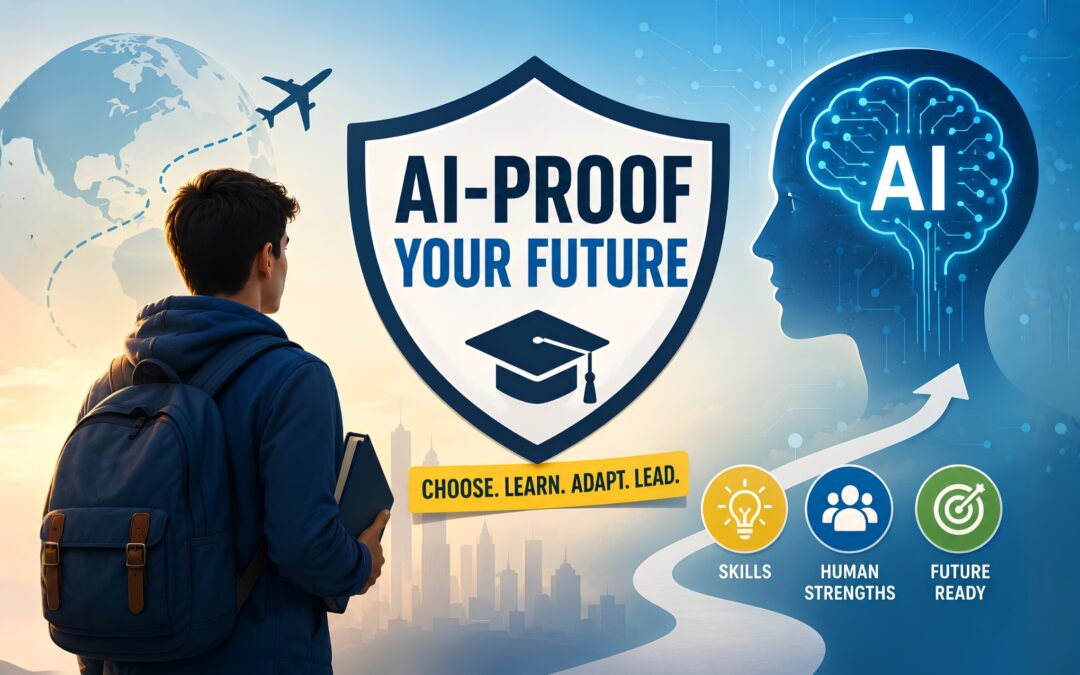
Probably not in the absolute sense. But it can absolutely be AI-ready, AI-relevant, and much more resilient if it teaches the right mix of technical fluency, human strengths, and real-world application.
The most AI-resilient students will probably not come from one single degree category. They will come from programs that combine subject expertise with flexibility, applied learning, and strong human judgment.
That is what students should really be looking for before choosing a course abroad.