
Is Your MBA Actually Worth It? The ROI Question Nobody Asks
Every year, thousands of students spend months obsessing over one number: their target school’s ranking.
They compare lists. They debate prestige. They build entire application strategies around the idea that if a school is ranked higher, it must automatically be the better decision.
Almost none of them ask the question that actually matters:
Which MBA gets me specifically to where I want to go and how fast does it pay back?
That is the question that should shape the entire decision.
Because an MBA is not just an academic purchase. It is a career investment. And like any serious investment, it should be judged on return, not just reputation.
This matters even more now because MBA applicants are making decisions in a tougher environment. Cost has become a bigger barrier, job-market uncertainty is more visible, and students are thinking much harder about whether the degree will actually change their trajectory. GMAC’s 2026 Prospective Students Survey found that 46% of candidates globally cited cost as a top barrier to graduate management education, while 20% cited uncertainty about job prospects after graduation. That tells you something important: applicants are no longer asking only, “Can I get in?” They are also asking, “Will this make financial and professional sense?”
That is exactly the right shift.
A good MBA can absolutely be worth it. It can accelerate your salary, expand your network, make a difficult career pivot possible, and give you access to employers who would otherwise be hard to reach.
But “worth it” depends on where you are starting, where you want to end up, how much you spend, how long you step out of the workforce, and whether the school actually has a track record of taking people like you to the places you want to go.
Here is a simple framework to find that out.
Step 1: Define Your “After” With Precision
Before calculating return, you need to know what you are returning to.
This is where a lot of applicants go wrong. They use broad, impressive-sounding goals that are too vague to evaluate properly.
They say:
- “I want leadership exposure.”
- “I want international opportunities.”
- “I want a better career.”
- “I want to move into business.”
None of that is useless. But none of it is precise enough to justify spending tens of thousands, or in some cases hundreds of thousands, on an MBA.
A stronger approach is to define your “after” in concrete terms:
- Industry: Consulting / Fintech / Finance / Tech / Luxury / Healthcare / Energy
- Function: Strategy / Product / Investment / Operations / Marketing / General Management
- Geography: Europe / North America / Southeast Asia / Middle East / India
- Seniority in 5 years: Manager / Director-track / Founder / Principal / Functional Leader
That level of clarity changes everything.
Because ROI is never abstract. It is personal.
A student trying to move from engineering into consulting in Germany is solving a very different problem from someone trying to move from marketing into product roles in the Netherlands. A candidate hoping to break into private equity has a different ROI lens from someone who wants to return to a family business with better strategic and financial training.
If you do not define the destination clearly, almost any MBA can look attractive. Once you define it, some programs immediately stop making sense.
Example
Take two applicants:
Applicant A says: “I want an MBA because I feel stuck and want growth.”
Applicant B says: “I want to move from operations into strategy consulting, preferably in Western Europe, and I want to be on a manager-track path within five years.”
Applicant B is already in a much stronger decision-making position.
Why? Because now they can ask useful questions:
- Which schools place into consulting in Europe?
- Which firms recruit there?
- How many alumni are in those offices?
- What is the likely salary jump?
- How long would it take to recover the investment?
That is how ROI thinking starts.
Counterpoint
Not everyone has total clarity at the beginning, and that is fine. Some people genuinely use the MBA to explore. But there is a difference between being open-minded and being undefined.
If you still cannot describe the role, geography, and industry you are targeting, you need to ask a harder question:
Do I need an MBA right now, or do I need more clarity first?
In some cases, a specialized Master’s may serve you better than an MBA at this stage, especially if your next step depends more on technical depth than on general management signaling.
Step 2: Map the School’s Alumni to Your Target
This is the most underused tool available to every applicant and it takes about three hours on LinkedIn.
Search alumni from your target school who graduated in the last five years. Filter by your target:
- industry
- company
- function
- country
- city
Then count what you find.
Not in a casual, “I saw a few people there” way. Count properly.
How many alumni from that school are actually working where you want to work?
That is one of the clearest indicators of whether the MBA is likely to deliver on your goal.
Why this matters
A school ranked #8 globally with 12 alumni in your target sector and city may be worth less to you than a school ranked #22 with 400 alumni in exactly the firms, offices, and roles you care about.
That does not mean rankings do not matter. They do. Rankings affect employer perception, applicant quality, and brand value.
But rankings are broad signals. Your career is specific.
The alumni network in your specific target is your real asset. Not the ranking.
That network shapes:
- who responds to your cold messages
- who is willing to refer you
- which employers are already familiar with the school
- what kinds of internships and interviews are realistically accessible
- whether the school has real relevance in your target geography
Student decision scenario
Imagine you want to work in European fintech. You compare two schools: one has stronger global prestige, the other has visibly stronger alumni density in Amsterdam, Berlin, Paris, Luxembourg, and London fintech roles.
If your goal is highly targeted and Europe-specific, the second school may produce stronger ROI even if it is less glamorous in a general ranking table.
That is not a downgrade. That is precision.
Counterpoint
There is one important caution here: alumni mapping is useful, but it is not the same as guaranteed placement.
A school may have strong alumni presence in a sector because it attracts people who were already good candidates for that sector. In finance especially, prior profile matters a lot. So do not read the data too casually.
Use alumni mapping as evidence of relevance, not proof of inevitability.
A better way to interpret it is:
- Does this school repeatedly place people into my target path?
- Do people with backgrounds like mine show up in those outcomes?
- Is the network deep enough to create real access?
That is the level of reading you want.
Step 3: Calculate Your Full Investment
Tuition is the number schools advertise. It is not the number that matters most.
The real number is:
Real Investment = Tuition + Living Costs + Lost Earnings
That third number is the one many students underestimate.
If you leave a job to study full-time, the salary you are not earning is part of the cost. So are foregone bonuses, promotion cycles, and the momentum you would otherwise carry in the workforce.
This is why program duration matters so much.
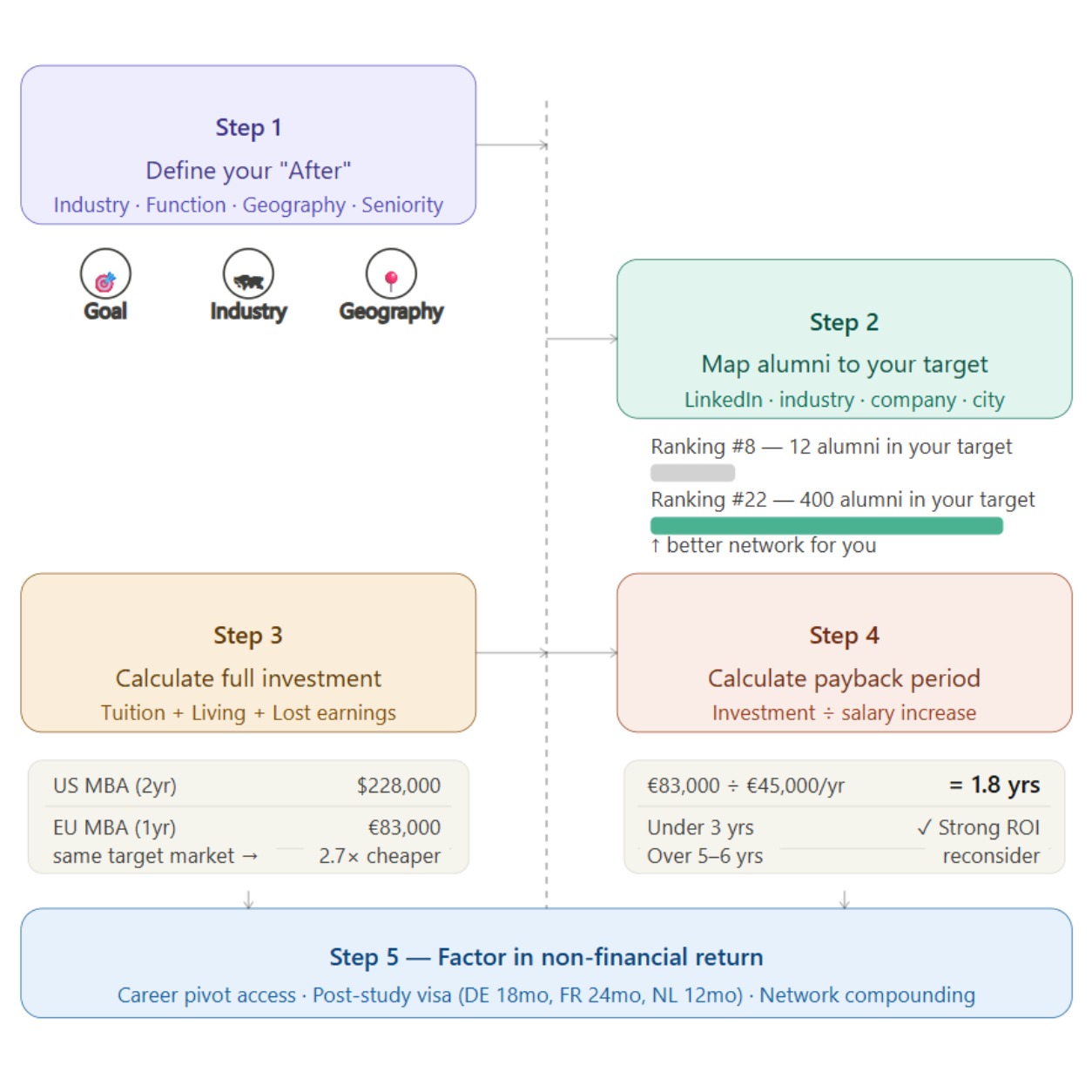
Illustrative example
2-Year US MBA
- Tuition: $120,000
- Living costs: $60,000
- Lost earnings: $48,000
- Total: $228,000
1-Year European MBA
- Tuition: €45,000
- Living costs: €18,000
- Lost earnings: €20,000
- Total: €83,000
These are illustrative numbers, not universal benchmarks. Real totals vary by school, scholarship, city, housing situation, and pre-MBA salary.
But the framework is correct. The longer the program, the more the economics shift.
That is why a one-year MBA can sometimes outperform a two-year MBA on ROI, especially if the target post-MBA market is similar.
What applicants often miss
Many students fixate on the prestige of a program and ignore how much extra cost they are absorbing for that prestige.
Sometimes that extra cost is worth it. Sometimes it buys access to a different recruiter set, a different geography, or a far stronger long-term network.
But sometimes it does not. Sometimes it is just a more expensive route to a very similar destination.
That is what you need to test.
Student decision scenario
Suppose two applicants want to pivot into consulting in Europe. One chooses a longer, more expensive MBA outside Europe. The other chooses a one-year European MBA with a strong local employer network.
If both end up in comparable consulting salary bands in Europe, the second candidate may recover the investment much faster, take on less debt, and preserve more financial flexibility in the first few years after graduation.
That does not mean the cheaper option is automatically better. The more expensive one may offer broader optionality or stronger global brand value. But the comparison needs to be explicit, not assumed.
Step 4: Calculate Your Payback Period
Once you know the total cost, the next step is simple:
Payback Period = Total Investment ÷ Annual Salary Increase
This is not the only way to measure ROI, but it is one of the clearest.
Example
A student currently earning €30,000 completes a one-year MBA and enters consulting at €75,000.
- Annual salary increase: €45,000
- Total investment: €83,000
- Payback period: under 2 years
That is strong ROI.
As a working rule:
- Under 3 years is often strong
- 3 to 5 years may still be reasonable, especially for a serious pivot
- Beyond 5 to 6 years deserves a much harder look
Why this matters
Payback period forces discipline. It moves the conversation away from “this school feels prestigious” and toward “this decision has a recoverable timeline.”
If the payback period is long, the MBA may still be worth it. But now you need a better reason:
- Is it buying access to a much higher long-term ceiling?
- Is it enabling a move you could not otherwise make?
- Is it opening a geography or sector that changes your career path materially?
If the answer is no, you may be overpaying for the signal.
Counterpoint: payback is not everything
A short payback period is attractive, but it is not the whole story.
Some students choose an MBA because it changes the shape of their career, not just the first-year salary. For example:
- someone moving from government into strategy
- someone leaving a technical role for general management
- someone relocating into a different labor market
- someone moving into a founder or investor ecosystem
In those cases, the ROI may compound over time rather than showing up fully in year one.
Still, if the payback period is weak and the strategic upside is also unclear, the decision deserves more skepticism.
Step 5: Don’t Ignore the Non-Financial Return
Three factors do not always show up neatly in salary comparisons, but they can significantly shift your ROI.
1. Career pivot access
For many students, the MBA is not mainly about a salary increase. It is about changing lanes faster than they could on their own.
An MBA can be the fastest route:
- from engineering into consulting
- from operations into strategy
- from government into private-sector leadership
- from a local market into a global one
If it compresses a transition that would otherwise take three to five years, that has real value.
A candidate in a back-end operations role may not be badly paid, but may have very limited access to strategy-track roles. If the MBA helps them break into a consulting or general management path with far stronger long-term growth, the early ROI may undersell the true return.
2. Post-study visa access
For international students, this can materially affect ROI. As of May 19, 2026:
- Germany generally allows graduates to stay for up to 18 months to look for skilled employment after completing a German degree.
- The Netherlands offers an orientation year residence permit valid for 1 year.
- France generally offers eligible graduates a 1-year post-study job-search or business-creation route.
These rules matter because time to secure the right job is part of the return. A degree is more valuable when it gives you a realistic runway to convert education into employment. A shorter or more restrictive route can change the risk profile significantly.
This is also one place where students should be careful about recycled advice online. Visa frameworks change. Country-specific rules should always be checked close to the application stage.
3. Network compounding
A strong alumni network keeps paying dividends long after the first job. It matters when:
- you want to change companies
- you want to change countries
- you are fundraising
- you are hiring
- you are exploring entrepreneurship
- you need fast, trusted industry insight
This is why one of the best questions you can ask alumni is: How often do you actually use your school’s network professionally?
Not whether they “liked the community.” Not whether they “met great people.” Whether the network actually helped in practical career terms. That is the answer that matters.
Which MBA Fits Your Career Line?
Different goals require different kinds of schools and different evaluation criteria.
Consulting
If you are targeting consulting, prioritize:
- schools with visible recruiter access
- placement history into major firms
- alumni density in the offices and regions you care about
- strong case interview preparation culture
Programs such as HEC Paris, INSEAD, and London Business School are regularly part of this conversation in Europe because of their employer visibility and network strength.
Finance / PE
If you are targeting finance or private equity, prioritize:
- alumni in relevant funds and financial hubs
- location strength
- employer access
- your own pre-MBA profile fit
Finance ROI is often highly dependent on prior experience, not just the school.
Tech / Product
If you want tech or product roles, look beyond general prestige and ask:
- which schools place into the companies I want?
- where is the startup ecosystem strongest?
- which geographies actually make sense for my post-MBA target?
- does the school have product-focused alumni I can map?
Entrepreneurship
If you want to build something, employer salary may matter less than:
- founder network
- incubator support
- investor access
- quality of peers
- ecosystem relevance
Again, this is why ROI must be personal.
Before You Apply: A Quick Checklist
Before you commit to an MBA, ask yourself:
- Defined your target industry, function, and geography
- Mapped alumni in your target role, company, and location
- Calculated total real investment, not just tuition
- Estimated your payback period using realistic salary assumptions
- Spoken with at least two alumni from each serious contender
- Considered whether a specialized Master’s may suit your stage better
- Verified current post-study work options in your target country
If you have not done these things yet, you are still looking at MBAs. You are not really evaluating them.
Final Thought
The students who get the best return from business school are not always the ones who got into the highest-ranked program.
They are the ones who chose with precision.
- They asked where they wanted to go.
- They checked which school actually led there.
- They counted the full cost.
- They measured the payback.
- They talked to alumni.
- And they treated the MBA as a strategic investment, not a prestige purchase.
That is the ROI question. Ask it early. Run the numbers honestly. Talk to the alumni. Then decide.
FAQ
Is an MBA worth it financially?
An MBA can be worth it financially if the degree leads to a meaningful salary increase, stronger long-term career access, or a faster career pivot that justifies the total cost.
How do you calculate MBA ROI?
A practical MBA ROI formula is total investment divided by annual salary increase. Total investment should include tuition, living costs, and lost earnings while studying.
What is a good MBA payback period?
A payback period under three years is often considered strong, while a payback period above five to six years usually deserves closer scrutiny.
Does ranking matter when choosing an MBA?
Ranking matters, but it should not be the only factor. Alumni outcomes, employer access, network strength, and target geography often matter more for actual ROI.
Is a one-year MBA better for ROI?
A one-year MBA can produce better ROI when it reduces tuition costs, living costs, and lost earnings while still delivering strong career outcomes in the target market.
What matters more: MBA prestige or MBA outcomes?
For ROI, outcomes matter more. A school’s value depends on whether it helps you reach your target role, industry, and geography at a justifiable cost.