Luxembourg for Master’s & MBA Students: Why Smart International Students Are Looking Beyond Traditional Study Destinations
Everyone talks about studying in Europe.
But very few students stop to ask a sharper question:
Where in Europe are the industries of the future actually growing?
That question matters more today than ever before.
For years, international students followed a familiar study abroad map. The UK for business. Germany for engineering. France for management. The Netherlands for international education. These destinations still matter, and they continue to offer strong academic and career value.
But the world of work is changing faster than traditional study destinations are adapting to it.
Today, companies are no longer hiring only finance graduates, only technology graduates, or only management graduates. They are looking for people who can move across disciplines.
- A finance student who understands AI.
- A business graduate who can interpret data.
- A tech professional who understands strategy, compliance, and regulation.
- A manager who can work with digital tools, sustainability goals, and cross-border teams.
This shift is exactly why Luxembourg deserves more attention from Master’s and MBA students.
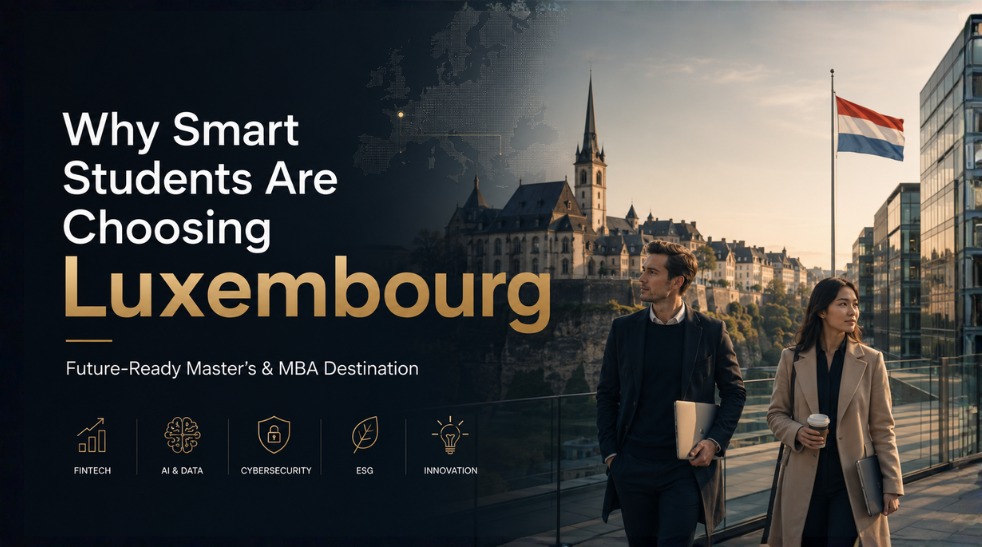
Not because it is “trending.” But because it sits at the intersection of some of Europe’s most future-facing sectors: global finance, FinTech, sustainable investment, digital transformation, cybersecurity, data, AI, business services, EU-linked institutions, and cross-border professional networks.
For students planning a Master’s or MBA abroad, the bigger question is no longer: “Which country is most famous?”
It is: “Which place prepares me for the next 10 years of work?”
That is a very different conversation. And Luxembourg belongs in that conversation.
The Shift Students Are Beginning to Notice
A Master’s degree or MBA is no longer just about getting another qualification. It is increasingly about positioning.
- Where are you studying?
- What industries surround you?
- What kind of professionals will you meet?
- What kind of problems does the local economy solve?
- Will your degree connect with the direction in which the world is moving?
Five or ten years ago, many students could still build careers in silos. Finance graduates stayed in finance. Technology graduates stayed in technology. Business graduates moved into management. Cybersecurity was treated as a technical back-end function. Sustainability was often seen as a reporting requirement, not a business priority.
That model is fading.
Today, employers across Europe are looking for hybrid talent. Business graduates need analytical thinking. Finance professionals need technology exposure. Managers need to understand AI, automation, and digital operations. Consultants need to work with data. Founders need to understand regulation, funding, sustainability, and international markets.
The future belongs to professionals who can move between industries, not remain trapped inside one.
This is why destination choice matters. A student is not only choosing a country for education. They are choosing the environment that will shape their thinking, exposure, network, and career direction.
Why Luxembourg Is Becoming Relevant for Master’s and MBA Students
Luxembourg has long been known as one of Europe’s leading financial centres. But reducing Luxembourg only to “banking” misses the bigger picture.
Today, the country has developed into a highly international business and innovation ecosystem connected to finance, investment funds, FinTech, sustainable finance, cybersecurity, digital transformation, data, AI, startups, and European policy-linked work.
Luxembourg’s Ministry of the Economy describes the country as a hub for startups and scale-ups looking to grow in Europe, supported by its central European location and multilingual culture. It also notes that Luxembourg’s startup ecosystem now includes around 700 startups, with public-sector support focused on innovation, entrepreneurship, scale-up growth, and attracting international entrepreneurs and investors.
For Master’s and MBA students, this matters because education is becoming ecosystem-driven. A classroom can teach frameworks. But an ecosystem teaches relevance.
Luxembourg’s strength is not just that it has strong sectors. Its strength is that these sectors overlap.
- Finance is becoming digital.
- Technology is becoming regulated.
- Business is becoming data-driven.
- Sustainability is becoming financial.
- Cybersecurity is becoming a boardroom issue.
- AI is becoming part of everyday management decisions.
That overlap is where many future careers will be built.
Luxembourg Reflects Where Europe’s Future Industries Are Heading
One reason Luxembourg is interesting is that it reflects the direction in which Europe itself is moving: smaller, smarter, highly international, more regulated, and more innovation-led.
The country is not trying to compete by being the largest destination. It competes by being connected, specialised, and strategically positioned.
Luxembourg is closely associated with finance and investment, but it is also becoming increasingly relevant in newer fields such as FinTech, sustainable finance, digital transformation, cybersecurity, data strategy, and startup development.
Luxembourg’s national digital direction is also worth noting. The government’s data strategy describes data as a major driver of innovation, economic growth, public services, and digital transformation. It also identifies data, artificial intelligence, and quantum technologies as strategic areas within Luxembourg’s broader digital sovereignty ambitions.
For students, this is important because future-facing careers rarely grow in isolation.
- AI needs regulation.
- Data needs governance.
- Finance needs technology.
- Cybersecurity needs business understanding.
- Sustainability needs investment structures.
- Management needs digital fluency.
This is the kind of environment where a Master’s or MBA student can begin to see how different disciplines connect.
The Rise of New-Age Master’s Programmes
Across the world, students are moving away from purely traditional degrees and toward programmes that combine business, technology, analytics, finance, sustainability, and innovation. This is not just a university trend. It is a workforce trend.
Students want degrees that help them answer questions like:
- How will AI change business decisions?
- How does finance work in a digital economy?
- What does cybersecurity mean for companies?
- How do ESG rules affect investment?
- How do startups scale across borders?
- How do managers make decisions using data?
Luxembourg’s ecosystem is especially relevant to students exploring these areas.
FinTech and Digital Banking
Modern finance is no longer limited to traditional banking. The financial sector now involves digital payments, blockchain infrastructure, compliance technology, AI-powered banking systems, digital asset regulation, cybersecurity, and cross-border financial services.
Luxembourg has built a visible FinTech ecosystem through platforms such as the Luxembourg House of Financial Technology, which connects FinTech firms, institutions, and innovators. The LHoFT reports that from 2017 to 2025, its community hosted over 200 FinTech firms, included FinTechs from 30+ countries, and supported companies that collectively raised over €1 billion in five years.
For students interested in finance, technology, or business strategy, this kind of ecosystem is valuable because it shows where financial careers are moving. Finance is no longer only about spreadsheets and markets. It is also about platforms, data, security, regulation, and innovation.
AI, Data Analytics and Business Intelligence
AI is no longer reserved for coders and engineers. Businesses now expect managers and analysts to work comfortably with predictive analytics, AI-assisted decision-making, data visualisation, automation tools, customer intelligence, and strategic analytics.
This is especially important for MBA and Master’s students. A future manager does not need to become a full-time software engineer. But they do need to understand how technology affects decision-making, operations, finance, marketing, risk, and strategy.
Luxembourg’s government has also placed data and AI within its digital development priorities, which signals that the country sees these areas as part of its future economic direction. For students, this means Luxembourg is not only a place to study business in the traditional sense. It is a place where business increasingly connects with data, AI, digital transformation, and innovation policy.
Cybersecurity and Digital Risk
As companies digitise their operations, cybersecurity has become a leadership-level issue. It is no longer only an IT department concern. Companies now need people who understand risk management, digital governance, data protection, cyber compliance, enterprise security strategy, and the business impact of digital threats.
Luxembourg’s Ministry of the Economy identifies cybersecurity as part of its work in information technologies and describes cybersecurity as an important factor in the country’s economic attractiveness and digital trust.
This creates an important opportunity for international students. Cybersecurity is not only for students with a purely technical background. It is also becoming relevant for business students, MBA candidates, risk professionals, finance graduates, legal professionals, and consultants. In a digital economy, every serious organisation needs people who can understand risk.
Sustainable Finance and ESG
Sustainability is no longer just a moral conversation. It is now deeply connected to finance, regulation, investment, reporting, and business strategy.
Europe continues to lead many conversations around ESG reporting, green investment, responsible finance, and sustainability-linked regulation. Luxembourg plays a visible role in this ecosystem. Luxembourg for Finance describes the country as a leading international platform for sustainable finance, supporting responsible investment funds, blended finance, green bond listings, ESG fund labelling, and other sustainable finance activities.
For Master’s and MBA students, this is a serious signal. Students interested in finance, sustainability, policy, consulting, investment, and international business can no longer treat ESG as a side topic. It is increasingly part of mainstream business decision-making. A student who understands both finance and sustainability may have a stronger profile than one who studies either area in isolation.
Why This Matters Especially for MBA Students
MBA students today are entering a very different job market from the one that existed a decade ago. Traditional post-MBA pathways still exist: consulting, finance, operations, leadership, strategy, entrepreneurship, and general management. But these pathways now demand a stronger understanding of technology and transformation.
Companies increasingly expect future managers to understand:
- AI-driven business models
- Digital operations
- Innovation systems
- Cross-border strategy
- Data-led decision-making
- Regulatory awareness
- Sustainable growth
- Cyber risk
- Startup thinking
For MBA candidates with backgrounds in engineering, finance, consulting, entrepreneurship, IT, operations, or family business, Luxembourg can be an interesting destination because its economy connects many of these areas. The ecosystem is more integrated. And that is useful for MBA students who want their degree to be more than a classroom experience.
A Small Country with a Highly International Ecosystem
One of Luxembourg’s biggest strengths is not size. It is connectivity. The country is compact, but its professional ecosystem is deeply international. It brings together government institutions, corporate offices, financial organisations, technology companies, startup networks, legal and policy institutions, and professionals from many nationalities within a relatively small space.
For students, this can be a real advantage. In larger destinations, it is easy to feel lost. Students may be one among thousands, competing in highly crowded markets with limited visibility.
Luxembourg offers a different possibility. Because the ecosystem is compact, proactive students may find more direct access to events, institutions, professionals, networking platforms, and industry conversations.
This does not mean opportunities are automatic. In fact, Luxembourg can be highly competitive. Its expat-driven environment means students must bring strong skills, communication ability, adaptability, and the confidence to stand out. But for students who are prepared, the compactness of the country can become an advantage. It allows them to become visible. And in today’s job market, visibility matters.
The Cost Question: Expensive, But Not One-Dimensional
Luxembourg is often seen as expensive. That is fair. Accommodation, food, lifestyle, insurance, transport, and daily expenses can be higher than in many other European countries. Students and families should not treat Luxembourg as a cheap destination.
But the cost conversation should not stop there. Luxembourg operates in a high-income economy. The point is not to say that every student will automatically earn a high salary after graduation. That would be unrealistic. The point is that Luxembourg’s economy functions at a high-value professional level, which is why it attracts international talent, companies, investors, and institutions.
So the smarter ROI question is not: “Is Luxembourg expensive?”
The better question is: “Can I build the kind of profile, skills, network, and adaptability needed to compete in Luxembourg’s economy?”
That is a more honest way to look at value. Luxembourg is not cheap. It is not easy. It is not automatic. But for the right student, it can be strategically valuable.
Luxembourg Is Not for Every Student
This is important. Luxembourg should not be sold as a shortcut. It is not the right destination for students who only want a familiar English-speaking environment, a large Indian student community, or an easy post-study promise.
It is better suited for students who are:
- Serious about international exposure
- Open to multilingual and multicultural environments
- Interested in business, finance, technology, data, sustainability, policy, or innovation
- Willing to network actively
- Comfortable with competition
- Ready to differentiate themselves
In Luxembourg, a degree alone may not be enough. Students need skills, communication, initiative, adaptability, and a strong reason for choosing the country. That is exactly why Luxembourg is interesting. It rewards students who are not just looking for a destination, but for an ecosystem.
The Bigger Shift in Study Abroad Decisions
The most important shift in international education is this: students are no longer choosing countries only because they are popular. They are choosing environments that feel future-ready.
That means asking better questions:
- Which economies are adapting fastest?
- Which industries are growing?
- Where are innovation and employment connected?
- Which countries are investing in digital transformation?
- Where do business, technology, finance, and sustainability overlap?
- Which destination helps me prepare for the next 10 years of work?
For Master’s and MBA students, this matters deeply. A postgraduate degree is a major investment. Students are not only investing money. They are investing time, energy, career direction, and family trust. So the destination must make sense beyond the brochure.
Luxembourg reflects where Europe itself is heading: smaller, smarter, international, multilingual, regulated, finance-led, technology-enabled, and innovation-focused.
That is why smart international students are beginning to look beyond traditional study destinations. Not because the old destinations have lost value. But because the future of work is becoming more complex. And students need ecosystems that prepare them for that complexity.
For the right Master’s or MBA student, Luxembourg may offer exactly that. Not noise. Not hype. But relevance.
Final Thought
The best study abroad decision is not always the most popular one. It is the one that places you closer to the industries, networks, skills, and opportunities that match your future.
For students planning a Master’s or MBA abroad, Luxembourg deserves attention because it is not just another European country. It is a compact, international, high-value ecosystem where finance, technology, sustainability, data, policy, and innovation often meet.
And in a world where careers are becoming increasingly interdisciplinary, that intersection matters.
The future will not belong only to finance graduates, tech graduates, or management graduates. It will belong to professionals who can connect ideas across all three. That is why Luxembourg may be worth a serious look.
Not Sure Which Country Is Right for You?
Confused about whether Luxembourg, Hungary, Germany, France, the UK, or another destination fits your profile? At One Window Overseas Education, we help students compare countries based on academic goals, career direction, budget, work opportunities, industry exposure, and long-term ROI.
Book a free country-shortlisting call and find out whether Luxembourg is the right fit for your Master’s or MBA journey.